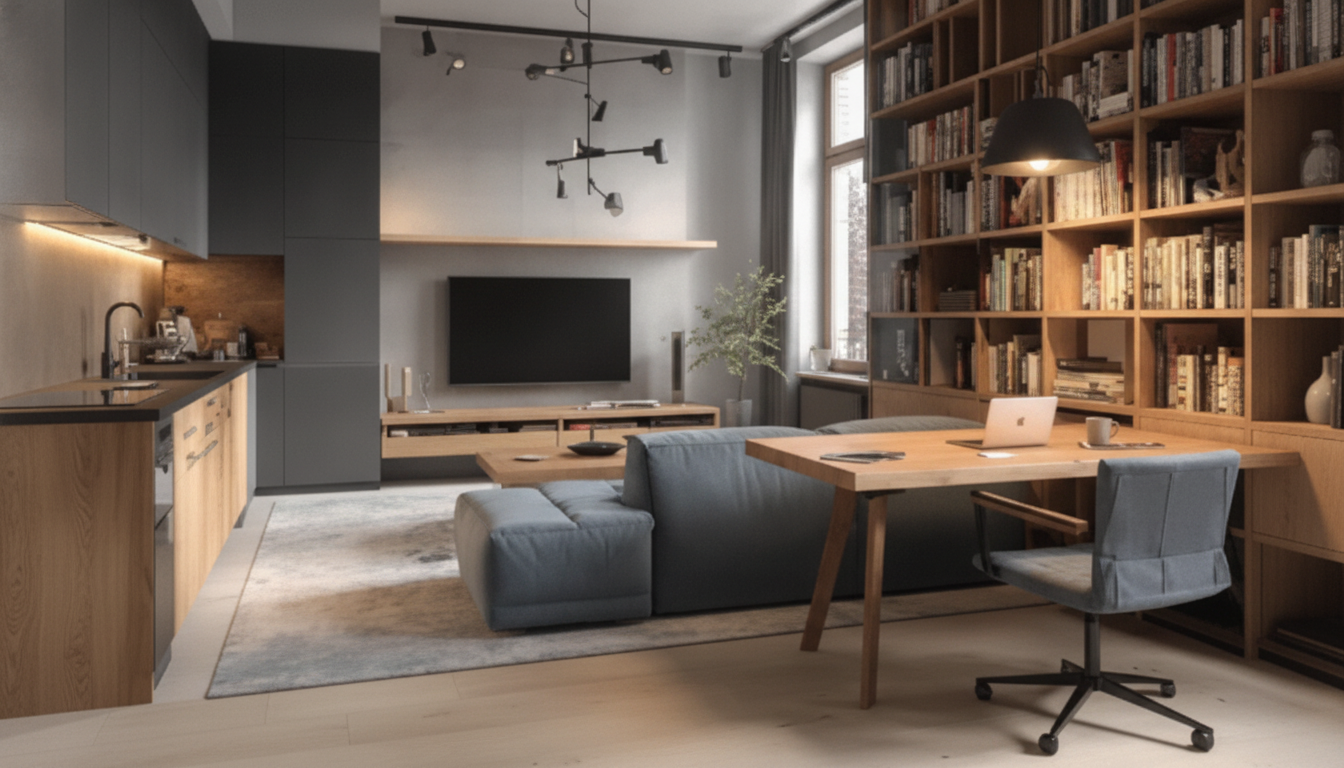
A single room often needs to function as a workspace, a place to relax, and a spot for hobbies or guests. The most successful multifunctional rooms feel intentional, not crowded—because zones, storage, lighting, and “quick-change” elements are planned from the start. Below is a practical, repeatable way to build a 3-in-1 room that works on a normal weekday, not just in photos. For more guidance, see Multifunctional Spaces in Urban Design – Modulyss.
Before shopping or rearranging, define what the room must do and what can’t change. This prevents the classic outcome: one function works, the other two become clutter piles. For further reading, see Multi-Purpose Design: Hybrid Spaces for a Sustainable Future.
If accessibility or mobility is a concern, plan your circulation path early. For reference guidance on clearances and accessible routes, consult the ADA Standards for Accessible Design (2010).
| Room uses | Primary challenge | Design move | Quick-change element |
|---|---|---|---|
| Home office + guest room | Bed dominates the space | Use a wall bed or daybed; place desk perpendicular to bed line | Fold-down bed or daybed trundle |
| Living room + workspace | Work setup feels messy after hours | Create a “work nook” with vertical storage and cable control | Rolling file cabinet or closing cabinet doors |
| Studio apartment + dining | Table competes with circulation | Choose expandable/drop-leaf table and stackable seating | Drop-leaf/extendable tabletop |
| Bedroom + fitness | Equipment spreads across the floor | Assign one wall for storage; keep floor zone clear | Wall hooks + lidded bin for grab-and-go gear |
| Kids’ play + adult lounge | Visual noise from toys | Use closed storage at adult eye level; open bins at kid height | Large baskets that slide into a credenza |
A 3-in-1 room succeeds when each function has a “home,” even if the room is small. Zoning reduces the feeling that everything is everywhere.
Practical example: make the desk zone your “primary” if you work daily, a reading chair as the “secondary,” and a guest sleep setup as “occasional.” The occasional zone should store compactly and set up quickly.
Multifunctional rooms don’t require tiny furniture; they require smart furniture. The goal is fewer pieces that do more, with a clear plan for where things go when you switch modes.
If your work function is essential, consider adding a backup-power plan for your tech, especially in areas with outages. A compact option like the Portable 200W Solar Generator with AC Outlet & USB Ports can keep a laptop, router, or task light running without turning your living space into a tangle of extension cords.
When replacing bulbs, efficiency matters—especially in rooms where lights run long hours. The ENERGY STAR light bulb guidance is a solid reference for choosing efficient options and understanding brightness.
If stress or mental fatigue is part of your work-from-home reality, a simple routine paired with focus habits can help the room feel calmer. The digital guide Calm at Work: Smart Strategies to Manage Stress and Boost Focus is a practical companion for building better boundaries between “on” and “off” time.
If you want a more structured way to plan (especially before buying furniture), How to Design One Space for Many Uses: 3-in-1 Multifunctional Space Design Bundle focuses on turning one room into three functional modes without constant mess.
Keep work contained to a dedicated zone with closed storage, strong cable management, and a simple “shut down” routine. Then use lighting as the switch: task lighting off and warm ambient lighting on to change the mood fast.
Prioritize vertical storage, choose raised-leg furniture, and maintain a clear circulation path. Define zones with rugs and lighting instead of bulky dividers, and rely on closed storage to reduce visual clutter.
A wall bed or daybed keeps the room functional during the day, while a desk with drawers (or a rolling file cabinet) keeps work supplies contained. Add a small surface that can act as both bedside table and printer stand, plus lighting that supports both reading and focused tasks.





Leave a comment