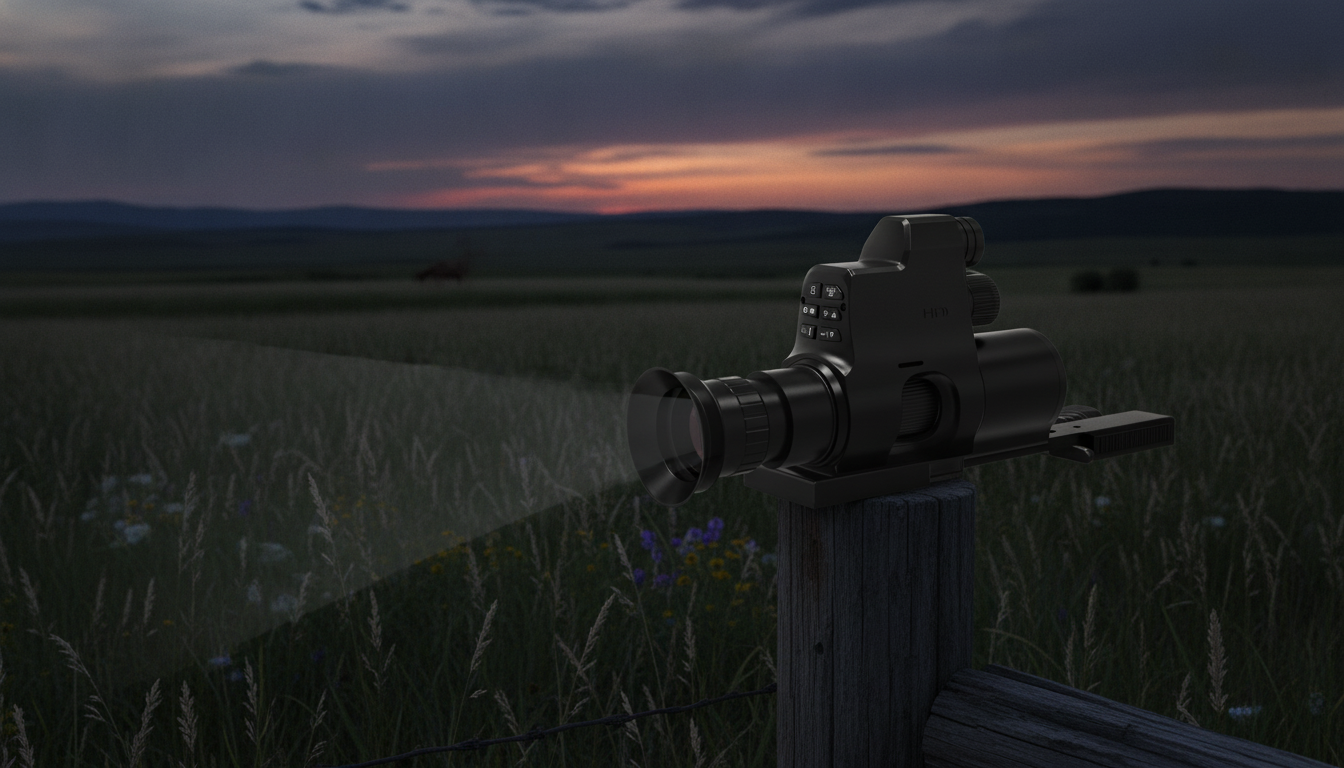
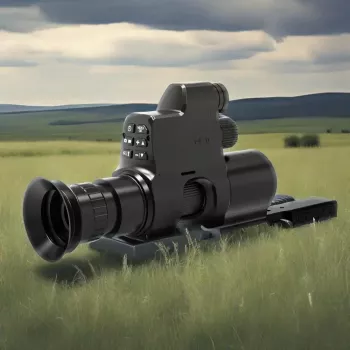
A compact night-vision monocular is often the simplest way to get eyes on a dark tree line, a back gate, or a trail edge without hauling bulky gear. The Monocular Night Vision Scope 4X Zoom HD 1080P with IR and 300m Range combines 4X zoom, HD 1080P recording, and infrared (IR) illumination designed to help you see when ambient light drops to near-zero. It’s a practical fit for wildlife viewing, camping, and property checks where quick scanning matters as much as image clarity.
4X zoom is a sweet spot for handheld night viewing: enough magnification to help separate “something moved” from “that’s a deer” at moderate distances, while still manageable without a tripod. At higher magnification, handshake becomes more visible—so technique matters as much as the number.
Infrared radiation sits beyond visible red light on the electromagnetic spectrum, which is why it can illuminate a scene without a bright white beam. If you’d like a deeper explanation of what IR is, see Encyclopaedia Britannica’s overview of infrared radiation.
Being able to record can turn a quick look into something you can replay: confirming tracks on a trail cam path, logging wildlife timing, or saving a clip of an unknown disturbance for later comparison.
A one-eye device keeps weight and bulk down. For hikes, glovebox storage, or a quick lap around the barn, a monocular format is often easier to grab than binocular-style night units.
Night-vision range claims are best read as “maximum detection under favorable conditions,” not guaranteed identification at that distance. A clear, open field can let you observe farther than a brushy corridor where branches scatter IR light and block sightlines. Weather also plays a major role: fog, mist, and heavy humidity can shorten useful range by reducing contrast and scattering light. The National Weather Service guidance on fog and visibility helps explain why distant objects fade faster in those conditions.
IR is powerful, but it’s easy to overdo—especially at closer ranges. For better detail and a more natural-looking image, treat IR intensity like a dimmer rather than an on/off switch.
If you’re aiming to minimize visible lighting around camp or at a rural property, the International Dark-Sky Association’s practical lighting guidance is a helpful resource for maintaining awareness while reducing unnecessary glare.
For extended nights outdoors, pairing night-vision use with a dependable backup power source can be helpful. The Portable 200W Solar Generator with AC Outlet & USB Ports is a convenient option for charging compatible devices during trips or off-grid checks.
| Spec | What It Means in Practice |
|---|---|
| Zoom | 4X for closer viewing of distant subjects; stability becomes more important at higher magnification. |
| Video resolution | HD 1080P recording for clearer playback and easier identification than lower-resolution options. |
| Infrared (IR) | Enables viewing in very low light or darkness; best results come from using the lowest effective intensity. |
| Stated viewing range | Up to 300m in suitable conditions; actual usable detail varies with weather, terrain, and reflectivity. |
| Form factor | Monocular design favors portability and quick scanning. |
Yes. IR illumination can provide a view even with no visible ambient light, though clarity depends on distance, reflectivity of the scene, weather, and how high you set the IR level.
In real use, you’ll typically detect shapes and movement farther than you can identify fine details. Identification distance is usually shorter than the maximum claim and improves with steady bracing, correct focus, and the lowest effective IR level.
4X is often enough for field edges, trails, and property lines where you want a closer look without approaching. The biggest factors for perceived sharpness are keeping the monocular steady and matching IR intensity to the distance.




Leave a comment