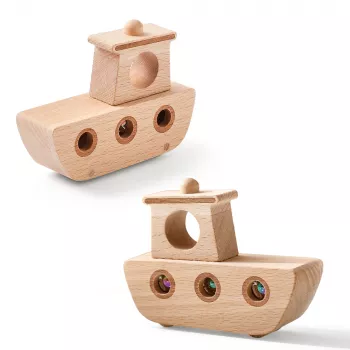
A simple wooden boat with rolling beads can keep little hands busy while supporting early sensory exploration. With a shape that’s easy to grasp and smooth bead tracks to follow, this type of toy encourages calm, focused play that fits naturally into daily routines—on the floor, in a play corner, or during quiet moments. The gentle movement of the beads offers immediate feedback without noise, lights, or batteries, making it a go-to option for screen-free play that feels soothing rather than stimulating.
If you’re building a small rotation of baby-friendly manipulatives, the Montessori Wooden Sensory Boat Toy with Rolling Beads for Baby Learning is designed around simple motion and hands-on discovery—two things babies naturally seek as they learn how their bodies interact with the world.
The appeal is in the “just enough” design: a pleasing object to hold, a predictable pathway for the beads, and a motion that invites repetition. Repetition is where many early skills strengthen—especially when the activity doesn’t overwhelm a baby with too many features at once.
Many babies begin to experiment with purposeful movement during the first year—reaching, grasping, transferring objects between hands, and using simple problem-solving when something doesn’t move the way they expect. For a helpful overview of age-typical development, the CDC milestones guide is a practical reference for what many children work on around this stage (CDC — Important Milestones: Your Baby By One Year).
| Play action | What to notice | Skills supported |
|---|---|---|
| Roll a bead from one end to the other | Child adjusts force to keep the bead moving | Fine motor control, cause-and-effect |
| Turn the boat to change the angle | Child experiments with tilt and gravity | Problem-solving, spatial awareness |
| Hold the boat steady while moving beads | Hands take different roles (steady vs. move) | Bilateral coordination, core stability |
| Pause and restart the motion | Child repeats patterns and anticipates results | Attention, self-regulation |
A simple routine might look like this: place the boat toy on a small tray, sit nearby, demonstrate one smooth roll, then pause. If the baby reaches for it, let them try. If they mouth it, that’s also part of sensory exploration—just keep supervision close and ensure the toy is made for safe handling and a smooth finish.
For caregiver-guided play, use short, concrete language: “Roll,” “Stop,” “Again,” “Slow,” “Fast.” This supports language exposure without turning play into a quiz. The goal is calm engagement and hands-on discovery.
For broader toy safety reminders (including supervision and selecting age-appropriate items), the American Academy of Pediatrics provides a clear overview: HealthyChildren.org — How to Choose Safe Toys.
This wooden sensory toy features a boat shape and rolling beads for hands-on learning. It’s suited to quiet play, travel-friendly setups, and simple daily routines, and it can be a budget-friendly way to add a tactile manipulative to a baby’s toy rotation. For caregivers building a calmer home rhythm, pairing focused child play with supportive adult routines can also help—resources like Calm at Work: Smart Strategies to Manage Stress and Boost Focus can complement the same “less noise, more intention” approach during busy days.
| Item | Details |
|---|---|
| Product | Montessori Wooden Sensory Boat Toy with Rolling Beads for Baby Learning |
| Price | 11.51 USD |
| Availability | In stock |
| Product page | View product |
Many babies can start enjoying a bead-and-track toy once they’re reaching and grasping reliably and can sit with support for short play sessions (often around 6–12 months). Always follow the product’s age guidance and supervise closely, especially during mouthing stages.
Wipe the toy with a slightly damp cloth; use mild soap if needed, then dry immediately. Avoid soaking or dishwashers, and regularly inspect the wood and bead tracks for cracks, rough spots, or loosening parts.
Calming sensory toys tend to be quiet, simple, and predictable—offering repetitive motion and clear cause-and-effect without flashing lights or loud sounds. Offering the toy by itself (instead of alongside many other stimuli) can help support steadier attention and regulation.





Leave a comment