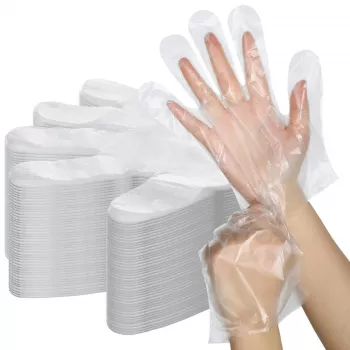
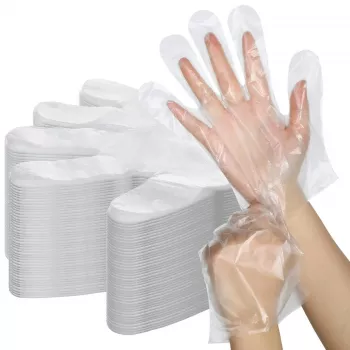
Some kitchen jobs get messy before you have a chance to reach for a towel. A pair of disposable plastic gloves gives you a simple, waterproof hand covering for brief tasks such as mixing a marinade, shaping patties, or portioning sticky ingredients. We like keeping a pair within reach for those moments—but using gloves well means knowing when to put them on, when to change them, and when another tool is the better choice.
Direct hand contact can make quick prep jobs easier. You might use a pair while coating vegetables with seasoning, shaping several portions of the same mixture, or handling ingredients that tend to leave color or odor on your hands. Transparent gloves let you see your hands and the food as you work, while the waterproof covering helps keep wet ingredients off your skin during a short task.
Gloves can also be useful for light cleanup, such as gathering food scraps or wiping up a small spill. Treat cleanup and food preparation as separate jobs, though. If you put on gloves to clear scraps or handle a dirty counter, discard them before returning to food. A glove can carry residue from one place to another just as a bare hand can.
These are everyday coverings, not a substitute for heavy-duty cleaning gloves or protection from a hot pan, sharp blade, or strong cleaner. When you can do a job neatly with tongs, a spoon, or a scraper, a utensil may be the simpler option.
Start with clean, dry hands before putting on a pair. Gloves do not replace handwashing: they can pick up contamination, and your hands still need washing when the gloves come off. Our Disposable Plastic Gloves – Transparent Waterproof Kitchen Gloves are a convenient option to keep nearby for short, messy kitchen tasks.
Set out your ingredients, utensils, and work area first. That way, you are less likely to touch a cabinet handle or your phone midway through food prep. Once the gloves are on, stay with one task when practical. After handling raw meat, poultry, or seafood, discard the pair, wash your hands, and put on a fresh pair before touching ready-to-eat food. Change gloves if they tear, become heavily soiled, or touch a phone, trash bin, or another surface you do not want to bring back into your prep work.
| Kitchen moment | Practical next step |
|---|---|
| Shaping several portions of the same food | Continue with the pair if the gloves remain intact and clean enough for the task. |
| Switching from raw ingredients to ready-to-eat food | Discard the pair, wash your hands, and put on a fresh pair. |
| Answering a phone or handling the trash | Change gloves before returning to food preparation. |
| Finishing a messy task | Remove and discard the gloves, then wash your hands. |
To remove a pair, peel each glove away without pressing its used outer surface against your bare skin. Discard the gloves after use rather than setting them aside for another job, then wash your hands. For more on handwashing, see the CDC’s handwashing guidance. The FDA’s food safety guidance for home kitchens is also a useful reference when planning how to keep raw foods separate from foods that are ready to eat.
Waterproof is a useful feature when you are briefly handling wet or messy ingredients. It does not mean the gloves are heat-resistant, cut-resistant, chemical-resistant, or sterile. Do not rely on a disposable kitchen pair to lift hot cookware, shield your hands from a knife, or protect you while working with a harsh cleaner. Choose equipment suited to the specific hazard instead: a dry oven mitt for hot cookware, safe knife-handling practices for cutting, and protection specified for the cleaning product you are using.
That distinction matters outside the kitchen, too. If you are working on a separate project with our Car Plastic & Leather Restorer – Back to Black Gloss Coating & Polish, do not assume a waterproof kitchen glove provides the protection that task calls for. Follow the product’s directions and use protective equipment appropriate for the job; keep car-care materials and food-prep tools in their own work areas.
We also avoid making decisions based on features that are not specified. A glove’s appearance alone cannot tell you its material composition, thickness, fit, or suitability for a particular type of food contact. For routine kitchen use, focus on keeping the pair intact, limiting it to a brief task, and changing it whenever your workflow calls for clean hands.
A little setup can make a disposable pair more useful. Open packages, arrange ingredients, and place the tools you will need on the counter before putting gloves on. If you are portioning food, set out a plate or container for finished portions so you do not have to search a cabinet with messy gloves. Use utensils for stirring or transferring food when they work well; save direct hand contact for the short steps where it genuinely helps.
No. Wash your hands before putting gloves on and after removing them, and change gloves between tasks that could spread contamination.
No. Discard the pair after handling raw meat, wash your hands, and put on a fresh pair before touching ready-to-eat food.
Do not assume so. Waterproof disposable gloves are not necessarily rated for heat or chemical protection; use equipment specified for those jobs.





Leave a comment