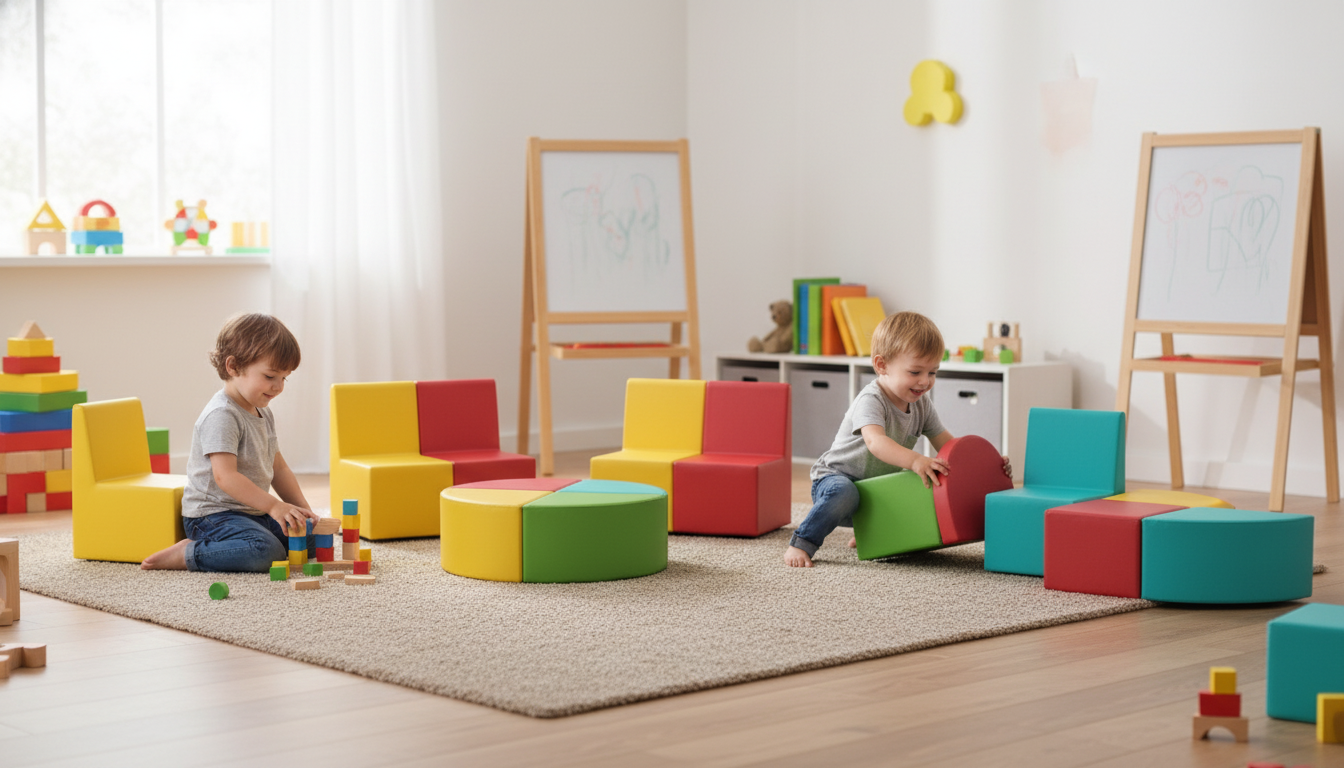
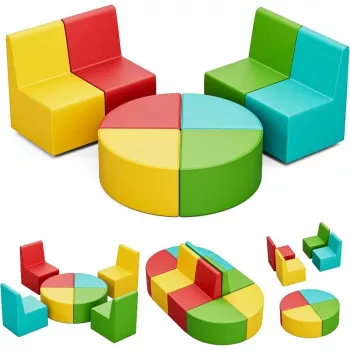
A modular kids sofa set can turn open floor space into a reading nook, a pretend-play stage, or a calm corner for breaks. With eight lightweight pieces that can be rearranged quickly, this colorful set supports both everyday play at home and high-traffic use in daycare settings where easy resets and flexible layouts matter.
Floor-level seating is often the missing “middle layer” in kids’ spaces: softer than the floor, safer than adult-height chairs, and flexible enough to keep up with changing activities. An 8-piece modular set is built to support daily routines without making the room feel locked into one layout.
If you’re shopping for a ready-to-use option, see the 8-Piece Colorful Kids Sofa Set with Flexible Seating for Playroom or Daycare.
With eight modular pieces, the set can function like a small sofa, a scattered seating circle, or a mix of cushions and supports. The biggest advantage is that kids can spread out when play gets active, then regroup fast when it’s time to read, snack, or reset.
| Setup | Pieces used | Best for | Notes |
|---|---|---|---|
| Mini couch + back support | Most or all pieces combined | Reading time, calm-down corner | Place near a bookshelf; add a soft rug to define the zone. |
| Circle seating | Pieces separated around a center | Group activities, daycare circle time | Keep a clear center for show-and-tell or music time. |
| Obstacle-free lounge line | Pieces arranged in a row | Quiet play, sensory breaks | Set along a wall to preserve walking paths. |
| Pretend-play counter / stage | Pieces stacked/paired | Imaginative play | Rotate themes: café, vet clinic, puppet show. |
| Two-zone room divider | Pieces arranged as low boundary | Busy rooms with mixed ages | Creates a visual boundary without blocking supervision. |
Where you place modular seating matters as much as how you arrange it. Good placement supports supervision, smooth transitions, and fewer collisions—especially when kids are moving between centers or stations.
For environments with strict daily schedules, pairing a predictable “reset routine” with staff-friendly tools can help. Some teams also keep a short focus or decompression resource on hand—like Calm at Work: Smart Strategies to Manage Stress and Boost Focus—to support consistent classroom pacing during high-energy days.
Kids use seating differently than adults do: they perch, sprawl, scoot, and turn furniture into props. Modular pieces are well-suited to that reality because the “wear” doesn’t land in one spot every day—layouts naturally change.
In multi-room facilities, planning for occasional power needs (music, white-noise machines, device charging for sign-in tablets) can also be part of the setup. A compact backup option like the Portable 200W Solar Generator with AC Outlet & USB Ports can be useful for preparedness, while keeping play areas uncluttered day to day.
For general children’s product safety guidance, review resources from the U.S. Consumer Product Safety Commission (CPSC).
For facility-friendly cleaning and disinfecting recommendations, consult the CDC’s cleaning guidance. If the space is used by children with sensitivities, it can also help to follow general best practices for air quality from the EPA’s Indoor Air Quality resources.
It depends on ages and how you arrange it. When the pieces are separated (cushions, small seats, and supports), a small group can share the set at the same time; when it’s configured as one couch-style build, it typically fits fewer children at once but offers a more stable “quiet corner” layout.
Modular seating is often better for daycares because it adapts quickly: circle time, station learning, and calm-down spaces can all use the same pieces. It also makes transitions faster when staff uses a default layout and keeps builds low and stable for supervision.
Create a stable couch-style arrangement near books or a simple sensory bin, and define the area with a rug so the boundary is obvious. Keep sightlines open for supervision, avoid door swings or hard corners, and set clear rules (resting and reading, not jumping or stacking).





Leave a comment