
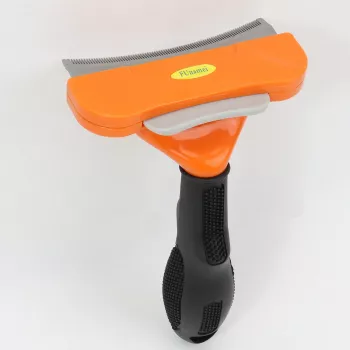
Loose fur has a way of turning up on the sofa, your clothes, and the floor. Regular brushing can collect some of it before it spreads, while giving you a chance to notice changes in your pet’s coat or skin. Our Self-Cleaning Cat & Dog Brush brings brushing and brush cleanup into one routine. The best place to start, though, is with your pet’s comfort—not a goal of removing as much fur as possible.
Choose a quiet moment when your cat or dog is relaxed. Let them investigate the brush before you begin, then use gentle strokes in the direction the coat grows. For a pet new to brushing, a few calm strokes may be enough for the first session. You can gradually do more as they become comfortable.
Watch your pet as closely as you watch the coat. Pulling away, tensing up, swishing the tail, or repeatedly trying to leave can mean it is time for a break. Pause rather than holding your pet in place to finish. Praise or a suitable treat afterward can help make the routine more familiar, but it should not be used to push through obvious discomfort.
There is no brushing schedule that fits every cat or dog. Coat length, tangles, shedding, and your pet’s tolerance all matter. Check the coat regularly and adjust your sessions to what you find. Short, smooth coats may need less attention than longer or tangle-prone ones, particularly when loose fur is more noticeable.
Our brush is meant to help you collect loose fur during a brushing session and clear the collected hair from the brush afterward. Removing fur as you go can make it easier to continue working in small sections and to leave the brush ready for next time. It does not replace careful handling: even with a convenient cleanup feature, gentle pressure matters.
Start on an area your pet usually accepts being touched. Move slowly, following the coat’s growth, and avoid repeatedly brushing the same spot. Be especially light around sensitive areas. As you work, look for tangles, dry patches, or anything else that seems different from your pet’s usual coat and skin. If a stroke catches, stop and investigate rather than pulling the brush through.
When you finish, clear the collected hair and keep the brush clean and dry. That small last step makes the next session easier to start. It also lets you see what the brush picked up, although the amount of fur in one session alone cannot tell you whether your pet has a health problem.
Use these starting points, then follow your pet’s response. Brushing should feel gentle; it should not require force to get through a knot.
| Coat situation | What to do | What to watch for |
|---|---|---|
| Short, smooth coat | Use gentle strokes and check for loose hair. | Sensitivity, dry patches, or a sudden change in shedding. |
| Longer or thicker coat | Work in small sections without pulling at tangles. | Knots that do not loosen easily. |
| Pet new to brushing | Keep early sessions brief and reward calm behavior. | Signs your pet needs a break. |
If you find a tight mat, do not tug at it or cut close to the skin. Mats can be difficult to separate safely, and skin may be closer than it appears. Ask a professional groomer or veterinarian for help instead. The ASPCA’s dog grooming tips and cat grooming tips offer additional guidance for building a care routine suited to each animal.
Routine brushing helps you become familiar with what is normal for your pet, but it is not a substitute for veterinary care. Contact your veterinarian if you notice irritated skin, bald spots, sores, or a marked change in shedding. Do not brush over a sore area to see whether it improves.
Depending on your pet, bathing, nail care, or professional grooming may also belong in the routine. One brush does not need to handle every grooming task. Keeping those jobs separate can help you choose the right approach when the coat needs more than a gentle pass.
Store the brush somewhere you can reach it during a quiet moment with your pet. A brief, positive session followed by clearing away the fur can be easier to repeat than waiting until grooming feels like a major chore. If fur also collects in your vehicle, handle that as a separate cleaning job: our Car Plastic & Leather Restorer is for compatible vehicle surfaces, not for pets or grooming tools.
Ready to add brushing to your routine? Explore our Self-Cleaning Cat & Dog Brush, begin with a comfortable pace, and let your cat or dog’s response guide each session.
Yes, our brush is offered for cats and dogs. Brush gently, adapt each session to your pet’s coat and comfort, and stop if brushing appears painful or irritating.
There is no single schedule for every pet. Start with short sessions and adjust based on coat length, shedding, tangles, and your pet’s tolerance.
Do not pull through a tight mat or brush over irritated skin. Ask a professional groomer about safe mat removal and consult your veterinarian about skin concerns.





Leave a comment