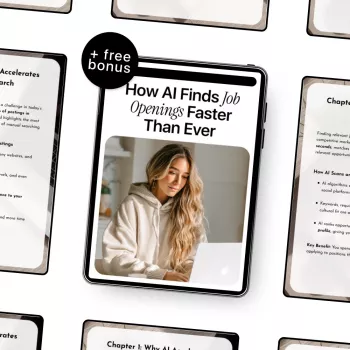
Job boards are only a slice of the real market. Roles get filled through internal pipelines, recruiter networks, and postings that disappear in days—sometimes hours. AI changes the job search by scanning more sources continuously, recognizing equivalent job titles across different wording, and alerting you faster than manual checking. The practical win isn’t just “seeing more jobs”—it’s turning early discovery into targeted applications and real conversations before a role is saturated.
If you want a structured workflow you can follow daily without drowning in tabs, our team recommends pairing a simple tracker with a discovery-and-execution routine. For a step-by-step version you can implement quickly, see our How AI Finds Job Openings Faster Than Ever | Smart Job Search Guide.
A clean setup usually has three layers: a monitor for discovery, a scorer for fit, and a writing assistant for execution. Prioritize tools that allow saved searches, email/app notifications, and easy export into one tracking sheet—your single source of truth for deadlines, contacts, and next steps.
| Tool type | What it does | Best for | Setup tip |
|---|---|---|---|
| AI-powered alerts | Monitors postings and sends notifications | Catching new listings early | Set 3–5 focused alerts by function + seniority + location/remote |
| Career page monitors | Tracks changes on specific employer pages | Target-company strategy | Start with 20–30 employers; expand only after responses improve |
| Matching & ranking assistants | Scores jobs against skills and preferences | Reducing irrelevant applications | Define “must-have” vs. “nice-to-have” to prevent over-filtering |
| Resume & cover letter assistants | Helps tailor bullets and summaries for each posting | Speeding up high-quality applications | Feed it role requirements + 5–8 quantified achievements |
| Outreach message generators | Drafts short recruiter/hiring manager notes | Increasing response rates | Keep messages under 80–120 words with one clear ask |
| Application tracker automation | Captures jobs, deadlines, contacts, next steps | Staying consistent for 30–60 days | Automate reminders at 2, 5, and 10 days post-apply |
To keep your pace sustainable (especially during heavy outreach weeks), our team also pairs job-search structure with stress management basics. If you’re balancing interviews with a full-time role, our Calm at Work: Smart Strategies to Manage Stress and Boost Focus guide can help you stay consistent without burning out.
For scam awareness and reporting guidance, the FTC’s consumer resource is a solid reference: FTC Consumer Advice: Job Scams. If you’re evaluating AI-driven hiring systems more broadly, the EEOC’s ongoing work is also worth knowing about: EEOC: Artificial Intelligence and Algorithmic Fairness Initiative.
Discovery tools (alerts, aggregators, and career page monitors) help you find roles early, matching tools rank them for fit, and execution tools speed up tailored resumes and outreach. If you want the biggest immediate lift, start with strong alerts plus a simple tracker, then add tailoring tools once your shortlists are consistently high quality.
Give AI your specific achievements and the job’s top requirements, ask for multiple variants, and then rewrite in your own voice while keeping every claim accurate. Make outreach feel human by adding one real detail that connects you to the team, product, or problem the company is working on.
Use reputable services, read privacy terms, remove sensitive identifiers when possible, and keep a local master copy of your resume and history. Avoid uploading ID documents and verify roles through official employer pages to reduce scam risk.







Leave a comment